Showing posts with label Atonement. Show all posts

Friday, September 10, 2010

The Three Most Important Realities of Life

I have the outstanding privilege every Tuesday and Thursday morning to gather with my brothers in seminary, read the Word together, worship together, pray together, and sit under wonderful exposition of the Scriptures together.

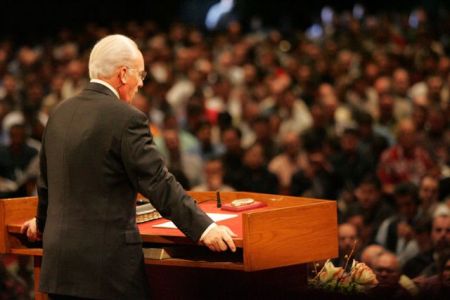
This Thursday morning was no different. We had the privilege of listening to the preaching of Rick Holland, which is always a pleasure. He is fast becoming a favorite of mine to listen to. He is a man who worships over the Word of God as he presents it, thereby helping those in the pews to worship over the Word of God as its presented. (I'm still praying God brings him back to the M. Div. program to teach preaching.)

Anyway, his message, entitled, "Ministry and the Reality of Death," treating Hebrews 9:27-28, was an absolute treat. It was the kind of sweet sting (or, stinging sweetness) that we all need to experience as often as we can, especially as it regards the universality and inevitability of death, the certainty of judgment, and the accomplishment of salvation in Christ. I talk a little bit more about that in this post, on why we need to talk about ultimate things in general and about hell in specific.

I really commend Rick's message to you. You can stream it by clicking here, and you can download it by clicking here. Please do yourself the favor, the benefit, of listening to his message.

He outlined the three most important realities of life from Hebrews 9:27-28, and they are as follows:
  1. Death is Unavoidable
  2. Judgment is Certain
  3. Salvation is Possible
These realities compel us to "preach the Gospel not some time, but every time."

And inasmuch as it is appointed for men to die once
and after this comes judgment,

so Christ also, having been offered once to bear the sins of many,
will appear a second time for salvation without reference to sin,
to those who eagerly await Him.

- Hebrews 9:27-28 -

Sunday, August 22, 2010

Atonement Q&A: A Contemporary Catechism

I've posted on Shai Linne before (here, here, and here), so I'm going to limit my introduction to this post. I'll only say that what he's given us in this song is akin to a contemporary catechism. If folks can memorize the sometimes inane and sometimes gruesomely irreverent lyrics to contemporary songs, imagine what they could do both for their soul and for the glory of Christ by memorizing this.


"Take to your heart all [these] words....
For it is not an idle word for you; indeed it is your life."

- Deuteronomy 32:46, 47 -

Sunday, July 4, 2010

Where the Contemplation of Our Freedom Should Point Us

I referred to the following post in last year's Independence Day post at For Our Benefit. It's entitled, "What Price Freedom?" and was written by PyroManiac Dan Phillips. Last year, I noted that I copied his post because everyone had written something with a 4th of July theme, and I, being a rookie blogger, didn't have anything prepared. I copy Dan's post this year, though, not (merely) because I wasn't ready for an Independence Day theme, but because I honestly don't think I could write -- or find elsewhere -- something better.

Enjoy. And Praise God for His gift of freedom. Political freedom, absolutely. But infinitely more important, praise God for freedom from sin.

“…and from Jesus Christ, the Faithful Witness, the Firstborn over the dead, and the Ruler over the kings of the earth. To Him who loves us, and loosed us from our sins by His blood; and He made us a kingdom, priests to His God and Father — to him be the glory and the might unto the ages of the ages! Amen!” (Revelation 1:5-6, my rendering)
In America, we enjoy a degree of freedom unknown throughout most of the history of the world. This freedom had its formal birth with the Declaration of Independence, July 4, 1776, in which the 13 colonies declared themselves independent of Great Britain, and which ended with the words “for the support of this declaration…we mutually pledge to each other our lives, our fortunes and our sacred honor.”

Was that just big talk, or flowery rhetoric? Well, the 56 signers were marking themselves as traitors to the Crown. “By the end of the war, almost every one had lost his property; many had lost wives and families to British guns or prisons; and several died penniless, having given all to the Revolution” (Larry Schweikart and Michael Allen, A Patriot’s History of the United States [Sentinel: 2004], 81).

Americans enjoy freedom today because of the blood spilt by thousands of men and women from before 1776 until this very day. Our freedom, as Americans, is not free. If it hasn’t cost us personally, it surely has cost someone else!

But my mind turns today to a far deeper bondage, however, and an infinitely greater freedom — and to the far more dreadful price that was paid for that freedom.

It is found in Revelation 1:5b: “To Him who loves us, and loosed us from our sins by His blood.”

I'd like to focus on two aspects only of that text: the love of Jesus, and the cost of that love.

As to the love of Jesus, we can discern four aspects here:

First, Christ's love is FREE. God is, by definition, the one and only truly free Being. He is under no external controls, subject to no overrides nor limitations. He can will and do anything in accord with His nature. Therefore, He was under no external nor moral compulsion to love guilty rebels. No committee or authority had petitioned nor ordered Him. Certainly His love was provoked by nothing in us — no foreseen faith, no anticipated holiness, as if the ultimate cause lay in us.

More accurately, He loves in spite of the continued rebellions, treacheries, and unbelief of the objects of His love. When He loves, He loves because He loves. It is the only satisfactory and Biblical answer.

Second, Christ's love is DISTINGUISHING. The text says that He loves "us." The context defines "us" as “His servants" and "his servant John" (1:1; cf. v. 4), as “the seven churches” (1:4), and as people who were “loosed …from sins… made… a kingdom, priests to his God and Father” (1:5-6). They are contrasted with false, pretend-Christians (chapters 2—3).

They stand apart from those who try to hide “themselves in the caves and among the rocks of the mountains, calling to the mountains and rocks, “Fall on us and hide us from the face of him who is seated on the throne, and from the wrath of the Lamb, for the great day of their wrath has come, and who can stand?” (Revelation 6:15-17).

It was a targeted love, a definite love, a particular love. There were people — "us" — whom Christ meant to free. Not "offer freedom to," but free, "loose."

Would anyone dare say He failed to free even one soul whom He determined to deliver?

Third, Christ's love is ETERNAL. John calls Jesus “Him who loves us.” The verb is present in tense, but it is a participle, not a finite verb. It marks no starting point, it erects no terminus. It isn't “Jesus loved us," nor "Jesus will love us.”

Being a verbal noun, it is a characteristic of Jesus'. It was true when John wrote it, it is true as we read it, it will be true through all the centuries and millennia and ages of eternity. Before the world began, He set His love on His own. When the last rebel fist has been shaken, and judged, still He will love His own.

This characteristic trumps all of the fears of God’s people. “But I am unworthy!” So are we all; yet Christ is He “who loves us.” “But I sin!” So do we all; yet Christ is He “who loves us.” “But I am going through a dark, awful time!” So have we all; yet Christ is He “who loves us.”

There is no “use by” date, no expiration, no sunset provision. Because it is eternal, it is invincible; nothing can separate us from the love of God which is in Christ Jesus.

Fourth, Christ's love is revelatory of HIM, not of US. If ever you find yourself starting a sentence, “Well, I think God loved me because I…” — bail out! Quick! Step away from the stupid statement! The only true and Biblical way to finish that is, “God loved because God loved." And the fact that God loved, and the wretches whom God loved, and the invincible fierceness with which God loved all say a great deal about God — and nothing about me.

Away with all self-help pop-psychologizing, that tries to find self-esteem in the Cross. Many say, “God loved me so much that He gave His Son to die for me — so I must be worth a lot! I must be worthy! I must be special!” I can’t easily imagine a more perverse line of reasoning. What the Cross says about us is that we’re helpless, we’re hopeless, we’re lost and doomed, and only the most extreme, radical, scandalous act on the part of God could redeem us from the wreck and ruin in which we’d buried ourselves!

The Cross says horrible things about us, as we are in ourselves, as Christ finds us! But it says wonderful things about God!

In fact, as a brief aside, to speak of loosing is to assume binding. That is, only those who are bound are interested in deliverance from their bonds. So what is it that binds us? The world, the flesh, and the Devil -- mighty, ubiquitous, tireless forces. [Sheerly because of the length of this post, I expand on this point elsewhere.]

Now let's turn to the COST undertaken by Jesus, because of His love: He freed us from our sins “by His blood.” We'll focus on three aspects.

First, Christ's blood is PRECIOUS blood. It is precious because of whose blood it is. It belongs to God’s Messiah, the Anointed One, the Faithful Witness, the ruler of the kings of the earth. It belongs to the blood of God incarnate; the Bible calls it the blood of God (Acts 20:28). This blood is of infinite worth. Dare anyone set a limit on the value of this blood? I would not! (It is a great misrepresentation of the Calvinist position to think that we do. We see its value as limitless, and its aim as specific.) Thus could Christ shed it on behalf of, and actually accomplish the redemption of, countless scores of multitudes of sinners from every nation, tribe and language.

Second, Christ's blood is PURE blood. The blood that looses us from our sins is itself that of a sinless Man. This is the blood of the one Man who did not share Adam’s guilt, and did not replicate Adam’s sin. It is the blood of one who never violated God’s law in thought, word or deed, who kept every bit of God’s law in thought, word and deed. Can the contrast between the Lord Jesus and those for whom He died be any starker and more immense?

Third, Christ's blood is POWERFUL blood. The apostle John does not say that Jesus made it possible for us to loose ourselves from our sins by His blood. Nor does He say that Christ made loosing from our sins available by his blood. Rather, Jesus Christ actually loosed us from our sins by His blood!

Christ's blood is powerful, and it is effectual. Can any imagine that a drop of that blood would be wasted, would fall to the ground defeated and impotent? I cannot.

Notice the wonders He accomplishes by His blood (vv. 5b-6). Before, we were lost, rebellious, hopeless, impure slaves. After, we are a kingdom, and we are priests. We need no mere man to rule us. We need no man to stand for us before God. We are members of Christ’s kingdom, and priests to God through Him.

This, my brothers and sisters, is freedom!

But at what a cost!

Now, it's beyond us to know who reads our posts. So let me just say, Dear Reader, if your thinking is, “Oh, I don’t need such a drastic conversion; religion is all very well for weak men and old ladies, but I have a fulfilled and meaningful life. I must follow my heart. I don’t need fairy tales to brighten up my life,” then you are still a slave to the world, the flesh, and the Devil. The worst slave is the one who has grown accustomed to his chains.

What power on earth can save us from these things? No power on earth! Only Christ can — but at what a dreadful price! No mere example, or teaching, or method can save. Only the blood of God incarnate can loose us from our sins! Do you know that freedom?

If you do, praise and honor Him alone who loves you, and loosed you from your sins at such a staggering price!

If you do not, throw yourself on the mercy of God, believe in the Lord Jesus Christ, look to Him this day!

Tuesday, June 1, 2010

Biblical Repentance: Introduction

Few doctrines of the historic Christian faith lie closer to the heart of the Gospel of Jesus Christ and the course of the Christian life than the doctrine of repentance. Indeed, when our Lord was said to first preach the Gospel of forgiveness of sins in His name, the first command He uttered was, “Repent” (Mk 1:15). Yet within Christendom – and even within Evangelicalism – there is widespread confusion and disagreement about the precise nature of repentance.

What does it mean to repent? What is the place of our feelings in repentance? Should we feel like we haven't repented unless we've felt sorry enough? Or should we confess and move on and trust that our feelings will catch up with us later? What about our works? Do we have to offer some sort of satisfaction for our sin beyond what Christ has accomplished, like feeling sorry enough or confessing to others? Or does the requirement of "obedience in keeping with repentance" undermine justification by faith alone? What is it, exactly, that God wants from us when we confess our sin and seek forgiveness? How should our walk with Christ look if we have a Biblical understanding of repentance?

Over the next couple of weeks I want to do a series on Biblical repentance. In the upcoming posts, I'll try to answer some of the questions I asked above in a number of ways. First, I'll examine three of the most common words used in the Bible to signify repentance. We'll study each word in its original Hebrew or Greek from a lexical and semantic perspective. The analysis of these words and their surrounding contexts will give us a theology of the nature of Biblical repentance. We'll see how Scripture uses these terms and look at what the authors of Scripture mean when they talk about repentance.

Once we have an idea about the nature of repentance, we'll look to apply that understanding to repentance both in justification and sanctification. In justification, we'll look at repentance as the sinner's turning from his sin as the ruling principle of his life. This takes place at conversion. Regarding sanctification, we'll look at the believer's habitual, ongoing repentance of specific sins throughout his Christian walk.

After this, I will spend some time contrasting Biblical repentance to the Roman Catholic doctrine of penance. That might seem a bit random, but I assure you that I'm not just going out of my way to pick on Catholics. The reality is, many Evangelical Protestants who would vehemently denounce the Roman Catholic doctrine of penance -- a sort of paying God back for your sins -- unwittingly practice penance while thinking they are practicing Biblical repentance. This is something that so many of us are prone to, because it is a natural human inclination to try to earn one's own righteousness before God. This goes to the heart of the Gospel, and calls into question the sufficiency of Christ's atonement.

Then, after all of those theoretical considerations, I'll do my best to specifically apply these principles to a practical counseling situation in which a church member has confessed to an immoral affair. I'll try to show how a Christian should come along side his brother and lead him to Biblical repentance while leading him away from the dangers of penance. This way, we can see what it would look like for us to practically live out these Biblical principles in the context of the body of Christ. Examining this hypothetical case study will also demonstrate how church leaders might evaluate the genuineness of a sinning member's repentance.

Finally, I'll conclude the series by presenting how my own study of the doctrine of repentance has affected me personally in my walk with Christ, and how I hope it will have affected you who undertake to study it with me. May God grant that this be a fruitful and beneficial endeavor, and that it serve to raise our affections high toward Him as we look into the wonderful things He's revealed in His glorious Word.

Satisfy us with Yourself, O God, as we carefully study the Word you have given us in order to see the beauty of Your manifold perfections with ever-increasing precision and clarity! And as we behold that glory, grant that we would become transformed into the very image of Your Son, that He might be the firstborn among many brethren and come to have the preeminence in everything, and that You might be honored above all things!

Amen.

Biblical Repentance: Introduction

Friday, May 7, 2010

Making Friends with Your Brother's Murderer

In my travels around the internet, I came across a sermon by Charles Spurgeon from which the following excerpt is taken. The name of the sermon is Lama Sabacthani? and was preached on the text of Matthew 27:46: Jesus' cry from the Cross. It was preached on March 2, 1890 at the Metropolitan Tabernacle in London. The below excerpt is his final exhortation and conclusion to the sermon.

Nobody says it quite like he does.
Let us abhor the sin which brought such agony upon our beloved Lord. What an accursed thing is sin, which crucified the Lord Jesus! Do you laugh at it? Will you go and spend an evening to see a mimic performance of it? Do you roll sin under your tongue as a sweet morsel, and then come to God's house, on the Lord's-day morning, and think to worship him? Worship him! Worship him, with sin indulged in your breast! Worship him, with sin loved and pampered in your life!

O sirs, if I had a dear brother who had been murdered, what would you think of me if I valued the knife which had been crimsoned with his blood? —if I made a friend of the murderer, and daily consorted with the assassin, who drove the dagger into my brother's heart? Surely I, too, must be an accomplice in the crime! Sin murdered Christ; will you be a friend to it? Sin pierced the heart of the Incarnate God; can you love it? Oh, that there was an abyss as deep as Christ's misery, that I might at once hurl this dagger of sin into its depths, whence it might never be brought to light again!

Begone, O sin! Thou art banished from the heart where Jesus reigns! Begone, for thou hast crucified my Lord, and made him cry, "Why hast thou forsaken me?" O my hearers, if you did but know yourselves, and know the love of Christ, you would each one vow that you would harbour sin no longer. You would be indignant at sin, and cry,

"The dearest idol I have known,
Whate'er that idol be,
Lord, I will tear it from its throne,
And worship only thee,"

May that be the issue of my morning's discourse, and then I shall be well content. The Lord bless you! May the Christ who suffered for you, bless you, and out of his darkness may your light arise! Amen.

Do not love the world nor the things in the world.
If anyone loves the world, the love of the Father is not in him.

For all that is in the world,
the lust of the flesh and the lust of the eyes and the boastful pride of life,
is not from the Father, but is from the world.
The world is passing away, and also its lusts;
but the one who does the will of God lives forever.

- 1 John 2:15-17 -

How shall we who died to sin still live in it?
- Romans 6:2 -

And He Himself bore our sins in His body on the cross,
so that we might die to sin and live to righteousness;
for by His wounds you were healed.

- 1 Peter 2:24 -

Friday, February 19, 2010

The Atonement: Real or Potential?


This past Sunday morning was a communion Sunday at Grace Community Church, and so John MacArthur took a break from his regular series in the Gospel of Mark and preached a sermon called, "The Atonement: Real or Potential?"

I thought it was an extremely helpful presentation of the Biblical doctrine of the particularity of the atonement of Jesus Christ. What was happening on the cross from a divine perspective? Why and for whom did Christ die?

I encourage you to download the sermon. It is well worth the listen.

And you shall call His name Jesus, for He will save His people from their sins.
- Matthew 1:21 -

Tuesday, January 26, 2010

Why Talk About Hell?

Isn't it primitive? Don't only really super-religious fanatics and superstitious fundamentalists believe in hell anymore? I mean, a place of fiery punishment where you go after you die unless you believe a certain thing? Aren't we beyond this?

Isn't it arrogant? I mean, how do we really know what's going to happen after death? And even if we did know, who are we to say who will or won't be where?

Isn't it just unseemly? "The smoke of their torment goes up forever and ever; they have no rest day and night" (Rev 14:11)? Can't we talk about more pleasant things? Isn't God a God of Love?

Such questions pour forth from the hearts of those people both in the world and, sadly, in churches throughout the world. Hell exists. Knowing and believing that is the first step toward being saved from being there.

Luke 16:23-24 - In Hades he lifted up his eyes, being in torment, and saw Abraham far away and Lazarus in his bosom. And he cried out and said, 'Father Abraham, have mercy on me, and send Lazarus so that he may dip the tip of his finger in water and cool off my tongue, for I am in agony in this flame.'

A while back (around six months ago), one of my mother's uncles died. He wasn't a believer. That caused me to think about Luke 16:19-31. After meditating on that passage for a while, I was struck with four reasons that Christians need to preach to our congregations about hell.

Christians need to know and to be affected by the fact that:

(1) Hell is what you deserve.
(2) Hell is what you were saved from.
(3) Hell is what Jesus endured for you.
(4) Hell is where the world is going.

#1 sparks the terror inside of me of God's righteous judgment and wrath and holiness. The rich man was in agony. His tongue was burning. And he had no hope of relief. Ever.

#2 speaks grace and relief to me. It is good news. I deserve to be there. But because of the grace of God to me in Christ, the power of the fear of death has been defeated. There is no longer any sting. I am saved.

#3 focuses all my affections of thankfulness, gratitude, joy, and delight, onto Jesus, because it was He who provided me #2. Because of the righteousness of Jesus, the perfection of His sacrifice, and His willingness to endure the full exercise of God's wrath -- hell -- in my place, I am saved. There is not one ounce of wrath or condemnation for me. Jesus fully satisfied God's anger against my sin.

But as I was meditating, #4 is what really gripped me. #4 hits the chord of compelling compassion as I consider that others are in the situation of #1 without #2 and #3. The world is dying. They're dying, and they refuse to believe it. Christians need to hear about hell from the pulpit because we need to have the magnitude and terror of what we were saved from compel us to take the Gospel to a world which is in that very desperate situation.

Hell is what you deserve.

And hell is what you will get apart from saving faith in Jesus Christ, from the One who promises that if you believe in Him for all your righteousness and rely entirely on Him for your acceptance before God (and not at all on yourself and your own works), that He literally endures hell in your place. He promises that you can be saved.

Hell is what Jesus endured in the place of those who believe. The agony that the rich man experienced with no hope of ever getting any relief is what you can be saved from by trusting Christ for righteousness and receiving Him as your Treasure.

And that's why we talk about hell. It forces the world into the ugly, disgusting reality of our deepest need -- really, our only need -- and then presents the most glorious and beautiful and satisfying and delightful Person as the alternative. The second question of the Heidelberg Catechism is: "How many things are necessary for thee to know that thou in this comfort [of knowing you belong to Jesus] mayest live and die happily?" The answer is:
Three. The first, how great my sins and miseries are. The second, how I may be delivered from all my sins and miseries. The third, how I shall express my gratitude to God for such deliverance.
In order to live and die happily, we need to know: (1) Hell is what I deserve; (2) hell is what I was saved from; and (3) hell is what Jesus endured for me.

But while we live in the satisfaction and the rest of being beneficiaries of the perfect work of Christ, let our souls also be afflicted by #4, that the terror from which I have escaped is the very hell to which the world is going. Let that compel us in compassion to take the Good News to that world, even one person at a time.

Open your mouth.

How will they hear without a preacher?

Wednesday, December 16, 2009

Better Christmas Stuff

Frank Turk, over at Evangel, has been doing a great series on Christmas. Specifically, he's talking about how the coming of Christ points us to the coming of God's wrath. That is, the reason Christ came into the world is that there was a problem: humanity was under the wrath of God and had no hope of escape. It's a good, sobering reminder to us all that in the midst of the decorations, shopping, Christmas trees, egg nog, and even nativity scenes on your lawn, Christmas is about the birth of a Savior. He came to save His people from their sins (Mt 1:21).

Anyway, I appreciated Frank's most recent post, and wanted to post it here as well. If any of you are tempted to think of Christmas as simply a quaint holiday that's mostly about family and friends and presents with an occasional hat-tip to Jesus, you're in danger of wasting your Christmas this year, and for the rest of your life. Frank exhorts us not to waste our Christmas. Enjoy.

My point, so far, is that God’s wrath is coming, and Jesus — whose birth we celebrate at Christmas — is the savior from that wrath. It’s a point a lot of people got because that’s what a savior is — and it’s a point I have made here before, so you were probably with me on it by way of preparation, one way or the other.

Now, the question is: is that enough? That is, if we understand that what we deserve is God’s wrath and what we get is God’s savior, can we now have some ham and some applesauce and some casserole and maybe (in presbyterian and Lutheran homes, of course) a glass of wine, a decent night’s sleep, and then open the presents on Christmas morn after an appropriately-solemn reading of Luke 2? I mean, seriously: enough’s enough.

Listen: Christmas is not about a logical argument, an intellectual affirmation, and then a secular session of either greed or idolatry (or maybe both). Christmas is about God with us.

When the Jews had the Temple, God’s wasn’t “with us”: He was nearby, to be sure, but He was separated ritually and physically from the people. He had a covenant with the Jews, and He gave them the means to sort of “pay up” or “make up” the ways in which they broke the covenant, but here’s what He says about that:

    For I desire mercy, not sacrifice,
    and acknowledgment of God rather than burnt offerings.

Two little lines in the book of Hosea — a book in which God says that the right way to see the relationship between Israel (the chosen nation) and God is that God is a faithful husband and Israel is a wife who prefers the life of a prostitute to the life of fidelity. But Hosea has to go and buy his wife back out of prostitution to make himself like God in this object lesson prophecy.

The obvious application is that God is coming back for us when we don’t deserve it — you’ve all heard that one, I am sure. But look: when God is spelling it out for Israel in Hosea 6:6, God is saying, “You know: I don’t want you just to think about what I have done this for you, I want you to acknowledge that I have done this for you and act like I am real to you.”

I think that’s a little dazzling, frankly. God doesn’t want to just save us: God wants us to act like a wife bought out of prostitution.

We don’t have to be people who are in it for the money anymore — because the price for us has been paid forever. We don’t have to work off our debt. Now, that sounds like standard christianese, I am sure — and the best way to overcome that is to describe for you in detail what the life of a prostitute is like. However, homeschool moms are reading this, and they would probably find that a little much — and they might be right. I’ll sum it up in a sentence: imagine a life in which your own body is not safe from the demands and impulses of others who care nothing about you. If you were stuck in a life where you don’t even own your own body, or have a right to your own flesh, how would you act toward the person who paid the price for your body and set you free from that kind of slavery?

That’s the razor’s edge at Christmas: it’s the place where mental assent doesn’t cut it. We can’t just agree that these things are true for us in some religious metaphor, or maybe in some metaphysical transaction. We have to be in love with the one who has actually done this for us. We have to live as if God is with us. God doesn’t want us to go and offer a dove or a lamb or a bull in the temple: God wants us to love Him above all things because He deserves to be loved above all things. And He should get it right now because He is worthy of it right now — in the same way you love your own spouse right now personally, passionately, and somewhat impulsively.

This Christmas thing — it shouldn’t be about an idea of God: It should be about God. In person. Here with us.

When we prepare for Christmas, we ought to be loving God in a real way — because He is saving us in a real way, and He is here with us. Welcome Him into your family and life as if He was your beloved husband and deliverer from slavery.

Monday, October 19, 2009

Leviticus at a Glance

In the book of Leviticus, Yahweh reveals His character and mind to the sons of Israel in the form of His holy Law.

He reveals Himself to Israel to impress upon them the standard of His holiness to which, as His people, they are held (Lev 10:3; 11:44-45; 20:7, 25-26; 22:32).


He reveals Himself to Israel to impress upon them the severity, seriousness, and pervasiveness of their sin before a holy God through very particular and arduous means of atonement.
  • Leviticus 1-7: The offerings for atonement (burnt, grain, peace, sin, and guilt offerings).
  • Leviticus 8-10: The priests' role in the offerings and in the atonement.
  • Leviticus 16: The laws for atonement in general and the holy Day of Atonement are instituted.
  • Leviticus 17: Yahweh requires that whatever sacrifices for atonement that are made must be made at the tent of meeting and nowhere else.
  • Leviticus 22: The animals that are sacrificed must be without defect.

And He reveals Himself to Israel to point them to a coming Great High Priest (Heb 2:17; 4:14; 6:20; 7:26; 8:1; 10:21) who would make a perfect and final atonement for them (Heb 7:25; 8:6; 9:23-24 10:12-14; John 19:30) something neither they nor their priests could ever do themselves (Heb 9:9-10; 10:1-4, 11).

Therefore, brethren, since we have confidence to enter the holy place by the blood of Jesus, by a new and living way which He inaugurated for us through the veil, that is, His flesh, and since we have a great priest over the house of God, let us draw near with a sincere heart in full assurance of faith, having our hearts sprinkled clean from an evil conscience and our bodies washed with pure water. Let us hold fast the confession of our hope without wavering, for He who promised is faithful.
- Hebrews 10:19-23 -

Thursday, September 24, 2009

Calvinism, John 3:16, and an Arminian Friend

A couple of months ago, I started thinking hard about what is and is not taught in the most famous, oft-quoted verse in the Bible: John 3:16. While that series of posts outlining my conclusions still lies in the future, I wanted to share an email response that was spawned out of that discussion.

My interlocutor is a dear brother in Christ, whose friendship and brotherhood I have long treasured. (I'll call him Jerry.) Jerry kindly responded to my email concerning John 3:16, probably suspecting that what I was trying to get at had something to do with a Calvinist vs. Arminian understanding of the passage. While that wasn't what I was getting at, I thought that the exchange we had would be particularly beneficial to share.

The following is my most recent response to him. I've reproduced only select portions of his original email to (1) narrow the scope of this post, and (2) to shorten this post to a semi-reasonable length.

Enjoy.

---
Hey Man,

So again, let me tell you that it was a joy to read through what you wrote. At so many of the points you made I found myself just saying, "Amen," and rejoicing and praising God. I particularly enjoyed considering Jesus as the serpent of Numbers 21 and the Son of Man of the book of Daniel, and how you said one image depicts His bringing salvation and the other depicts His deity. Wasn't anything new, but it's always nice to have Christ presented to you by your brothers. So, hear that.

But there were also some things that you presented that I disagree with, and would love the opportunity to present what I think is the Biblical position on some of the topics you brought up. I'll start here. You said:

The world…

I know some respected theologians believes that God offers salvation only to the elect… however I believe the context points toward God loving those that accept and those that reject Him.

I actually agree with you here, too, even though I'm a Calvinist. Some folks say that "the world" refers only to the elect. Some say that "the world" just means that it's in contrast to what Nicodemus would have thought (that is, that salvation would only be offered to Israel). So proponents of that view would say that "world" is contrasted with "just Israel" (as I believe it is in 1 John 2:2). But here, I believe that Jesus is saying that God has loved (note the past tense, denoting that this 'loving' is an action that took place at a particular time) the totality of fallen humanity in a particular way: by sending His Son to die for sinners. This would be contrasted with the angels, who were not loved like that to even have a Savior presented/offered to them, but were damned without mercy (2Pet 2:4).

That the gift of Christ’s atonement has the potential to pay the sin debt of every man ever created, however with all gifts of God (Romans 6:23) it is not forced upon us. We are responsible before God to accept the gift of salvation.

Here, though, I perceive some inaccuracies in the way of speaking about the atonement. First, let me state further some agreement with what you say. Neither of us believe in universalism, that is, that everyone in history will be saved. But for a second, let's imagine that they did. I don't believe that Christ would have had to suffer any more than He did to pay for the sins of every single person. That is, I believe the atonement to be sufficient to pay for the sins of every human being ever born.

However, I do not believe that that was the design of it, simply because not everyone will be saved. More on this to follow.

I do have a question about what you said. How do you support the point that none of God's gifts are forced upon us?

Also, you say that "we are responsible to accept the gift of salvation." I have to tell you, brother, I never find that kind of language in Scripture. We are never exhorted to accept a gift. We are exhorted to
believe, and so be saved. I would say that it is more Biblical to say that we are responsible before God to believe in Christ, or to obey the Son / obey the Gospel command to believe (John 3:36; cf. 2Th 1:8, 1Pet 4:17).

That whoever shall believe in Him...

Romans 10:9, Romans 10:13 – again it implies that anyone can get saved.

I disagree here. I think that these verses simply teach that anyone who believes (or, calls on the name of the Lord, Rom 10:13) will be saved. These verses simply teach the conditions that must be met for salvation. They do not say a word about whether or not all are able to meet these conditions. I don't think that you can accurately say that the statement of the conditions of salvation implies that anyone can meet the conditions. There's a jump there that the text doesn't make.

So the question becomes: who will meet this condition of faith for salvation? The answer is actually given at the end of the verse that Paul quotes in Romans 10:13. He's quoting Joel 2:32, but only the first half. Here's the whole verse: "And it will come about that whoever calls on the name of the LORD will be delivered; for on Mount Zion and in Jerusalem there will be those who escape, as the LORD has said, even among the survivors whom the LORD calls."

The ones who call on the Lord's name for deliverance, the ones who escape unto salvation, the survivors are those
whom the Lord calls. The ones who call on Him are only the ones that He first calls. The reason is because, apart from being given new life, eyes to see, and ears to hear, everyone without exception will remain under God's wrath (John 3:36), in their spiritual death (Eph 2:1-3), in their blindness (John 3:3), in their deafness (John 8:43, 47). It's important to see that John says that God's wrath remains on the unbeliever / the disobedient, because it means that it was already there by default. We were by nature children of wrath (Eph 2:3).

So unless something happens to us outside of ourselves, we will never believe, we will never obey, we will never choose God. Indeed, the mind set on the flesh is
hostile toward God; for it does not subject itself to the law of God, for it is not even able to do so (Rom 8:7).

And so in John 3:16, salvation by faith alone is offered to every single person in the world. That is love. It is the love of the offer of life. The great tragedy is that no one wants it, and everyone prefers to die in their sins. Our wills are too enslaved to our sin (John 8:34; Rom 6:6, 16-20) and hostile to God (Rom 8:7) to want anything else.

So, in what the Bible calls
great love (Eph 2:4), which is a love greater than the general love of John 3:16, God elects, or chooses, a people for Himself (Eph 1:4-5; Titus 2:14), and makes them alive (Eph 2:5), even when they were dead and wanted nothing to do with Him. According to His great mercy (a mercy greater than the mercy of John 3:16), He caused us to be born again (1Pet 1:3). In the exercise of His will, He brought us forth by the word of truth (James 1:18). Indeed, those who received Jesus, who believed in His name, they were born not of blood, nor of the will of the flesh, nor of the will of man, but of God (John 1:12-13).

The love of John 3:16 is a wonderful love. But it is not the greatest love that the Bible speaks about. I say that because it is a kind of love that can still let us go to hell. I can be loved by the love in John 3:16 and still die in my sins. But I cannot be loved by the
great love in Ephesians 2:4 and still die in my sins. No, by that love I have been made alive! By that love I have been born again! It is by His will that I was brought forth, and was given to His Son (John 10:29), and no one can snatch me out of the hand of the Son (John 10:28) or out of the hand of the Father (John 10:29)! Indeed, the only way we come to Jesus is if the Father draws us (John 6:44), and no one can come unless the Father grants it (John 6:65).

By
this great love, Jerry, God has overcome my hostile, enslaved will, even when I was refusing Him (Rom 1:18). By this love He has given me the grace to see the glory of Christ when I was once blind to it (John 3:3), and so having seen the beauty and delightfulness of that glory, I could never choose anything but Him. That's what I mean by what folks call irresistible grace; not that people never resist Jesus / the Holy Spirit, but that in this great love with this grace He overcomes my resistance, and shows me something irresistible: the glory of God in the face of Christ (2Cor 4:6)!

So I believe that the Bible presents that it is incorrect to talk about the atonement as if it
only made salvation possible. If that's the case, Jesus' death didn't actually atone for anything. It just made atonement possible. That would mean, then, as well, that what does atone is the sinner's choice. The difference between the believer and the non-believer is not God's grace, but that the believer chose to 'activate' the atonement and the non-believer didn't. I think that's foreign to Scripture, and thus a dangerous position to hold.

I think the Scripture presents Jesus' atonement as having
actually atoned, having actually purchased redemption for a people that God would call to Himself, and not for others.

  • In John 10:11, Jesus says He lays down His life for the sheep. He does not lay down His life for the goats.
  • In Acts 20:28, Paul says that God (Jesus) purchased the Church with His own blood. He did not purchase the whole world.
  • In Ephesians 5:25ff, Paul talks about Christ loving the Church by giving Himself up for her. He talks about sanctifying her and washing her so that He might present her to Himself. This is a particular people.
  • In Titus 2:14, Paul says that Jesus gave Himself to purify for Himself a people for His own possession. This is a particular people.
  • That's confirmed when this same phrase is used in 1Pet 2:9: That we are a people for God's own possession. There, that particularity is even connected to His sovereign choice, or a election, in that He calls us a chosen race.
  • In John 17:9 in the High Priestly Prayer, Jesus declares to the Father that He's praying for His people, and not the world. And the reasoning He Himself uses for doing this is because the Father gave only His people to Jesus, and not the whole world.
Now, it's important to remember what I said at the beginning of this email (so hard, I know, because of the length!). I do believe God loves the world by sending Christ. And I do believe that Jesus' death brought some good things to all people (i.e., common grace, the influence of God's people in their lives). This is what 1 Timothy 4:10 means when it says that Christ is the savior of all men, especially those who believe. That is, that all men are not damned instantly as the angels were (2Pet 2:4; Jude 6) and that they enjoy the common goodnesses that the Father sends (Matt 5:45) means that the death of Christ purchased some good things for them. But Christ saved "those who believe" especially, meaning that He saved them to the uttermost (Heb 7:25, KJV), in that He paid for their sins and actually redeemed them.

Christ could not have paid for the sins of everyone ever. If He did, all would be saved. But the Bible clearly teaches this isn't the case. You couldn't have Jesus paying for the sins of non-elect Jim, fully propitiating the Father's wrath against Jim's sin, and then because Jim doesn't believe have him be punished for eternity, under the Father's wrath. For those for whom the wrath of God has been propitiated (the elect), there is no wrath of God left (Rom 8:1). By definition, Christ has
satisfied, or fully extinguished the wrath of God towards those for whom He died. So if Christ paid the penalty for the sins of every single person everywhere, no one would be in hell unless Christ's sacrifice was not acceptable to the Father. But of course we know and believe that it was (Hebrews 9-10).

Alright... that's about enough, wouldn't you say? I welcome your response, even if it's in pieces! I hope that I've presented to you to the Word of God. It's out of a great desire for you to know Christ as He's revealed Himself, so that you can enjoy Him for all that He is in all His wonderful contours, and so that He can get the glory for being rightly seen and worshiped. I commend this teaching to you in love. I pray that it's a benefit to you, brother.

Tuesday, September 22, 2009

High Priest

I've posted previously on Christian rapper Shai Linne, and there I've commented in brief on what I think of "Christian rap."

I heard the following song after reading through the book of Leviticus twice, which was very fitting. The song is called "High Priest," and it's basically the experience that the Jewish high priest had on the Day of Atonement each year, told from the priest's perspective. Shai Linne is on point in capturing not only the accuracy and precision of those rites of worship, but the reverence and temerity that the book of Leviticus demands for worshipers of Yahweh.

As I listened to it I thought that our worship today with our hands and voices raised should be no less reverent and grave. It is a serious thing to approach the throne of God. He doesn't have to accept our worship. Our best, purest worship is like filthy rags (Is 64:6). But because of the great, sufficient, finished work of Jesus Christ, we can approach the throne of grace with confidence that He accepts our worship as it's bathed in His Son's blood (Heb 4:14-16; 10:19-22).

Anyway, enjoy the song. As you read the lyrics below, let it spur you on to pure and reverent worship. I encourage you to listen to the song twice, and click on all the links on the second time through.


There's commotion in my brain, strange is the notion,
Words cannot explain my range of emotion.
I'm speechless, my flaws exposed and my weakness,
Each breath draws me closer to a deep test.
It's month number seven, it's been ten days,
I've been awake all night reflecting on my ways.
A threat to my peace in this greatest of moments,
Because I'm the High Priest and its the Day of Atonement.
The LORD is so holy and perfect, I'm nervous,
I'm floored that He chose me to worship through service.
Don't ask me why the God who crafted the sky,
Drafted this weak guy from the clan of Levi.
Preceding generation taught me to read the regulations,
Deep meditation on decreed revelation.
Extreme trepidation breeds hesitation,
Yet I must lead and be the representation.
My occupation: to intercede for the nation,
But indeed my own sins need expiation.
The wrath of Jehovah's grim, sin is no joke to Him,
The hope is slim for unholy men coming close to Him.
He's spoken in His Word the proper way of approach to Him,
Nadab and Abihu got it wrong and He roasted them.
These things I weigh as I sigh,
This could either be the greatest day of my life or the day that I die!

Chorus

So you say that you wanna know the Lord?
Do you really wanna stand before the Lord?
Do you know what it takes to meet the Lord?
God is an all-consuming fire.
So you say that you wanna know the Lord?
Do you really wanna stand before the Lord?
Do you know what it takes to meet the Lord?
Be careful what you desire.

For now, no time to focus on my sinning,
I bathe in the laver though it seems extreme,
I put on the holy coat made of white linen,
Craving His favor -- I'm ceremonially clean.
I check to inspect -- no tangible faltering,
Next I must collect the animals for the offering.
A spotless ram and a bull -- the components,
God gives to make atonement for my own sins.
This part of the ritual makes me real cautious,
Because the very sight of blood makes me feel nauseous.
Still I proceed by snatching him close, slashing his throat,
When his blood splashed on my coat.
Reacting, I choke -- gasping that's when I'm grasping,
God's reaction that sin provokes.
I take a moment to reflect on the blood spilled in this,
Staring at the goat to be sent into the wilderness.
I'll confess Israel's sins with my hands on his head,
Symbolizing guilt transferred in stead
To a substitute the living God provided and stamped,
Guilty of our sin, driven outside the camp.
This beautiful picture of hope and grace motivates,
And I don't want my fear to make this dope occasion go to waste.
Change my outer garments, slow my pace, yo I brace
Myself to stand before Jehovah's face in the Holy Place.

Chorus

The time has come, the great moment has arrived,
About to enter in -- what a lonely enterprise.
Look at the other priests, they speak only with their eyes,
Rope tied around my ankle just in case I don't survive.
I enter through the first curtain to a dark room,
I'm standing in the Holy Place, my thoughts consumed.
I'm caught off guard, I'm unraveling at this stage,
My heart beats so hard it's rattling my ribcage.
Feeling like I'm disintegrating and I can't stand,
Comforted by the light emanating from the lampstand.
This helps my vision -- I can see the showbread,
I think of God's provision, that helps me go ahead.
I need courage to worship! Man, this is intense!
I take burning coals off the altar for the incense.
The sweet aroma fills the room,
The smoke protects my eyes -- one sight of Jehovah seals my doom.
It's no mere coincidence I'm here surrendering,
With fear and trembling I'm nearly entering.
I feel like running scared, hoping I'm not unprepared,
Stunned with fear -- no one comes in here but once a year.
Nevertheless I'm at the point of no return,
Besides, I don't want my anointing to be spurned.
After counting to three, next time I exhale,
I'm in the Holy of Holies, beyond the veil!
The first thing I realize is I'm thrilled that I've
Entered into God's presence and yet I'm still alive.
I'm awestruck by the weight of His terrible beauty,
It's almost unbearable but I must fulfill my duty.
Approach the ark, the first part of my works complete,
when I sprinkle blood seven times on the mercy seat.
Quickly I exit, impressed with the chesed,
that rescues the wretched and left us accepted!

Monday, September 7, 2009

Mission Accomplished

The following video is from Christian rapper Shai Linne. (There's much that can be complained about concerning whether Christian rap is legitimate. All I have to say for now is: the man is preaching better than scores of pulpits throughout America, let alone the world, and he can do it to music and make it rhyme.)

The song is called Mission Accomplished, off of his album The Atonement. That's exactly what he's talking about in the song. The atonement has been accomplished. I could offer more commentary, but he does it really well. The lyrics are written below. Don't miss his own commentary in between verses.

Here's the video. [Please excuse the images of Christ (Ex 20:4). I couldn't find a video in which there aren't any, and I don't know how to post the audio only.]


Lord knows He tried...

Here's a controversial subject that tends to divide,
For years it's had Christians lining up on both sides.
By God's grace I'll address this without pride.
The question concerns those for whom Christ died.
Was He trying to save everybody worldwide?
Was He trying to make the entire world His bride?
Does man's unbelief keep the Savior's hands tied?
Biblically, each of these must be denied.
It’s true, Jesus gave up His life for His Bride,
But His Bride is the elect, to whom His death is applied.
If on judgment day, you see that you can’t hide,
And because of your sin, God’s wrath on you abides,
And hell is the place you eternally reside,
That means your wrath from God hasn’t been satisfied.
But we believe His mission was accomplished when He died.
But how the cross relates to those in hell?
Well, they be saying...

"Lord knows He tried."

That's what they be saying. Cats be saying that He tried. But I'm sayin... did He try? And fail? Or did He succeed? Is there going to be one drop of the Savior's blood in vain? Nah, perish the thought. The Lamb will receive the reward for His sufferings.

Father, Son and Spirit: three and yet one,
Working as a unit to get things done.
Our salvation began in eternity past,
God certainly has to bring all His purpose to pass.
A triune, eternal bond no one could ever sever,
When it comes to the church, peep how they work together:
The Father foreknew first, the Son came to earth
To die -- the Holy Spirit gives the new birth.
The Father elects them, the Son pays their debt and protects them,
The Spirit is the One who resurrects them.
The Father chooses them, the Son gets bruised for them,
The Spirit renews them and produces fruit in them.
Everybody’s not elect, the Father decides,
And it’s only the elect in whom the Spirit resides.
The Father and the Spirit: completely unified.
But when it comes to Christ and those in hell?
Well, they be saying:

"Lord knows He tried."

So if we can agree that the election of the Father is not universal and the regeneration of the Holy Spirit is not universal, why would the atonement of the Son be universal? That would put the Persons of the Trinity completely at odds with one another. But the Triune God is completely unified.

My third and final verse, here’s the situation,
Just a couple more things for your consideration.
If saving everybody was why Christ came in history,
With so many in hell, we’d have to say He failed miserably.
So many think He only came to make it possible,
Let’s follow this solution to a conclusion that’s logical.
What about those who were already in the grave?
The Old Testament wicked, condemned as depraved?
Did He die for them? C’mon, behave.
But worst of all, you’re saying the cross by itself doesn’t save.
That we must do something to give the cross its power.
That means, at the end of the day, the glory’s ours.
That man-centered thinking is not recommended.
The cross will save all for whom it was intended,
Because for the elect, God’s wrath was satisfied,
But still, when it comes to those in hell,
Well, they be saying:

"Lord knows He tried."

Look. At the end of the day, this is about giving God the maximum amount of glory. We proclaim a Cross that actually saves. Not "makes salvation possible," but actually saves. Matthew 1:21: His name shall be called Jesus because He will save His people from their sins. Not "might save them," not "try to save," but, no, He will actually save them. It's a definite atonement. This ain't controversy for the sake of controversy or theological nitpicking.

Salvation is of the Lord. To Him belongs all the glory.